Article
Why Your Business Has Lots of Data but Few Useful Answers
Fix the gap between scattered metrics and clear strategy by transforming disconnected reports into actionable operational insights.
The Paradox: More Data, Fewer Answers
Most companies aren't suffering from a lack of data; they are drowning in it. Sales records, marketing touchpoints, financial ledgers, and operational logs hold critical signals, yet leadership still struggles to answer basic strategic questions.
When data lives in silos without shared context, dashboards become vanity metrics rather than decision-making tools.
The 6 Hidden Causes of Data Paralysis
These problems often sit underneath the reporting layer, making it difficult to move from data to a confident business decision.
Fragmented sources
Information is spread across systems and files.
Manual preparation
People assemble data before analysis can begin.
Different definitions
Teams do not always measure the same thing.
Timing gaps
Sources update on different schedules.
Missing context
Metrics show movement without explaining the driver.
Weak decision link
Reporting does not clearly connect to an action.
Reporting Tells You What Happened. Decision Support Helps Explain What to Do.
A standard report is useful when the objective is to monitor performance. The problem starts when the business expects a report to answer a question it was never designed to answer.
Consider a simple statement: “Sales dropped 8% last quarter.” That is a useful observation. It is not yet a useful decision.
Leadership may need to know whether the decline came from fewer customers, lower order frequency, a particular product, a specific market, or a change in customer behaviour. Those questions require the analysis to move beyond the headline metric.
The difference is not simply a more sophisticated dashboard. It is a different starting point: the decision the business needs to make.
| Standard reporting | Executive decision support | What changes |
|---|---|---|
| States what happened | Investigates what drove the change | Move from a headline metric to its relevant drivers |
| Summarizes past performance | Helps identify the relevant cause, risk, or opportunity | Explore the segment, product, market, or behaviour behind the result |
| Starts with available system outputs | Starts with a business question | Define the decision first, then identify the required data |
| Ends with a metric | Connects analysis to a possible action | Turn the finding into a decision or intervention to evaluate |
The 5-Level Analytics Progression
Transform analytics from a passive record-keeping exercise into an active growth driver by systematically answering five questions:
For instance, knowing that customer churn increased is useful. Understanding which customer segment is affected, what changed before the churn, what intervention to make, and whether it reduced churn is much more valuable.
- What happened? (Descriptive)
- Why did it happen? (Diagnostic)
- Where is the root opportunity or risk? (Exploratory)
- What action should we take? (Prescriptive)
- Did our intervention work? (Evaluative)
Build the Data Foundation Around a Decision
The answer is not necessarily a large enterprise data transformation. A better starting point is one important, recurring business decision.
Start with the decision itself. What choice does the business need to make repeatedly? Which questions need to be answered before that choice can be made?
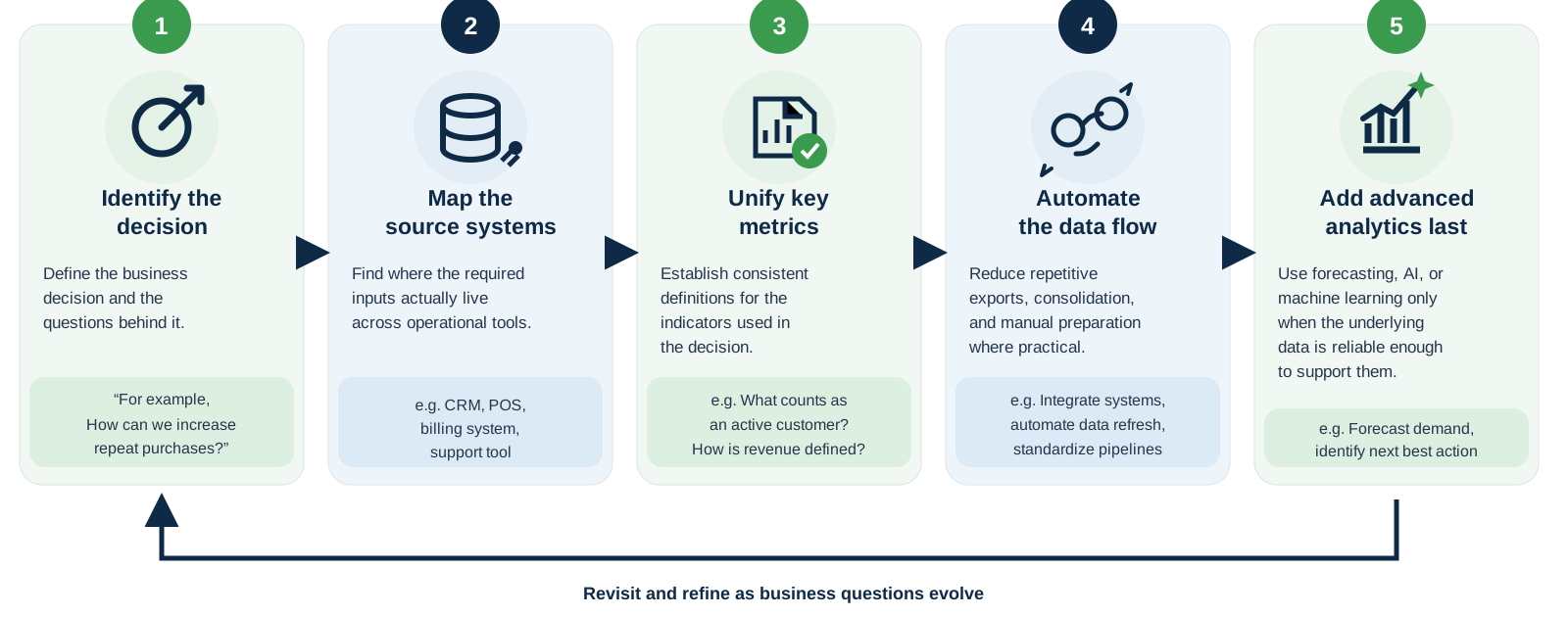
This order matters. If the business has not agreed on the metric or cannot reliably assemble the required inputs, adding another dashboard or an [AI layer](/resources/articles/ai-vs-traditional-automation) will not solve the underlying problem.
Start with One Decision, Not a Data Transformation Programme
A business does not need to fix every data problem before it can create value.
Pick one critical decision that happens often enough to matter. Build a reliable path from the relevant sources to the questions that support that decision. Measure whether the new approach reduces manual effort, improves confidence in the numbers, speeds up analysis, or leads to better decisions.
Once that works, the same approach can be extended to the next decision.
Start with one important decision. Then build the shortest reliable path from data to answer.